10 Best Garage Storage Systems for Organized Spaces
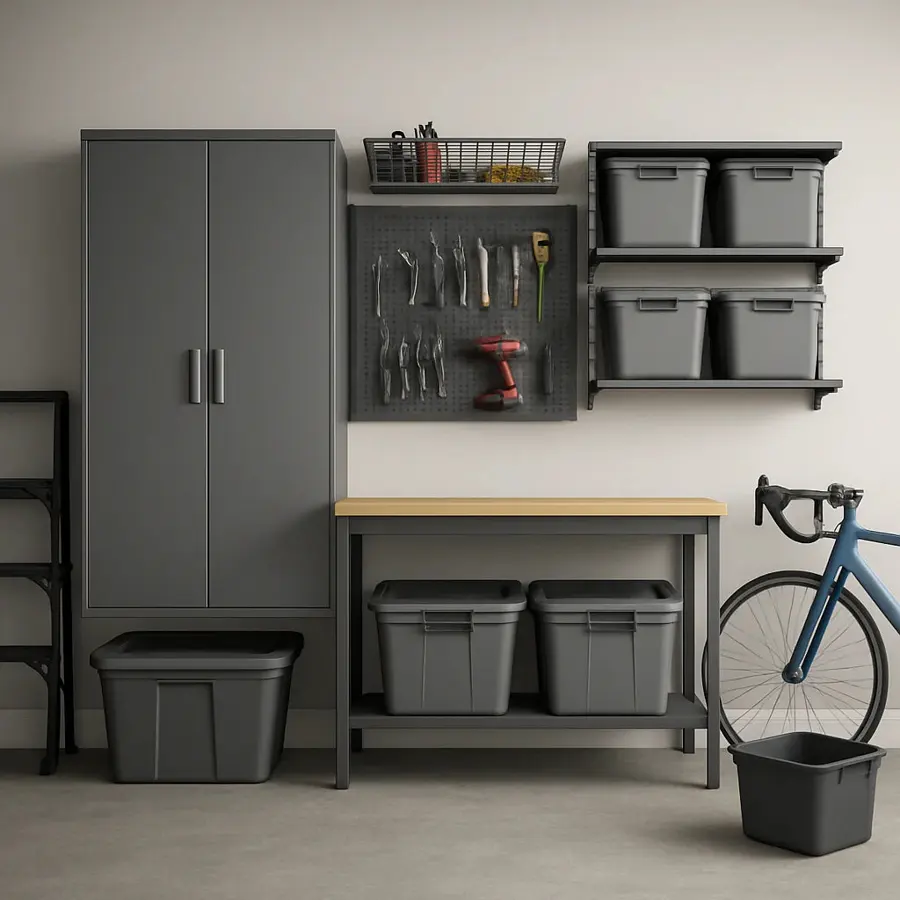
Garage storage works best when it is treated as a system, not as a pile of unrelated containers. The right mix depends on what you store, how often you reach for it, the condition of the walls and ceiling, and whether the garage still needs to fit a vehicle. This guide compares ten useful system types rather than pretending that one product is best for every room.
Quick Answer
Start with fixed shelving or cabinets for the everyday core, add wall storage for frequently used tools, and reserve overhead racks for lightweight or seasonal items that can be lifted safely. Choose equipment only after measuring door travel, vehicle clearance, outlets, studs or masonry, and the largest item that must fit. A coordinated system should keep heavy objects low, active tools within easy reach, and seldom-used containers clearly labeled above or at the perimeter.
Browse the full garage storage systems collection for current options, or use the ten categories below to decide which type deserves space in your plan.
Before choosing a storage system
Measure the garage with the vehicle parked where it normally sits. Record usable wall width, ceiling height, the open garage-door position, tracks, lights, attic access, windows, switches, outlets and any appliances that need ventilation. Then inventory belongings by size, weight and retrieval frequency. This prevents the common mistake of buying attractive panels or cabinets that cannot hold the awkward objects creating the clutter.
Installation capacity matters as much as product capacity. A rack rated for a substantial load still depends on correct fasteners, sound framing or masonry, proper spacing and an installation that follows its manual. Do not assume drywall alone is a structural mounting surface. If a ceiling or wall condition is uncertain, have it evaluated before hanging heavy storage.
1. Heavy-duty freestanding shelving
Freestanding shelving is the most adaptable starting point for totes, automotive fluids, garden supplies and household overflow. It does not require a proprietary hook ecosystem, and shelf heights can often be adjusted as needs change. Measure the depth carefully: a deep rack holds more but can narrow the vehicle aisle or hide small items behind large ones. Place dense supplies on the lowest shelves, keep leaking liquids in trays, and use labels that remain visible from the aisle.
See garage shelving when the main problem is stacked floor clutter rather than loose hand tools.
2. Enclosed garage cabinets
Garage cabinets create a calmer visual field and protect contents from ordinary dust and light. They are useful for power-tool cases, detailing supplies and items that should not remain exposed. Cabinet dimensions deserve close attention: exterior width does not equal usable shelf width, and a door may conflict with a parked vehicle or adjacent cabinet. A lock can discourage casual access, but it does not make a cabinet appropriate for every chemical, fuel or hazardous material. Follow product labels and local requirements for those items.
3. Slatwall or panel systems
Panel systems turn a broad wall into an adjustable field for hooks, baskets, shelves and holders. Their strength is reconfiguration: bicycles, tools and seasonal equipment can move without drilling a new hole for every change. Their limitation is compatibility. Panel profile, spacing, fasteners and accessory fit vary, so verify that future hooks are intended for the exact panel system. Plan the layout on the floor first, then mount the most frequently used objects between shoulder and waist height.
For an example of a panel-based route, compare the current slat-wall panel listing on Amazon, checking current dimensions, included hardware and seller details there.
4. Rail-and-hook storage
A horizontal rail offers a simpler wall-storage approach than covering an entire wall. It is particularly effective for hoses, ladders, folding chairs, long-handled tools and sports gear. Calculate the arrangement using the object’s full depth from the wall, not only its width. A bicycle or hose loop can project into a door path even when the rail itself fits. Keep sharp and heavy items away from doorways and below positions where they could fall onto a vehicle.
The garage wall storage collection brings together rails, panels and other vertical approaches.
5. Pegboard for small and medium tools
Pegboard is useful above a workbench because tools remain visible and can be returned to a defined position. Board material, hole pattern, standoff depth and hook design affect compatibility. A good layout groups tools by task rather than by shape: measuring and marking together, electrical tools together, and frequently used drivers close to the center. Heavy cases and bulky machines usually belong on shelves or in cabinets instead of occupying valuable pegboard area.
Compare garage pegboard storage and pegboard accessories before committing to a hook format.
6. Overhead rack storage
Overhead garage storage can recover space above a parked vehicle or along the back wall, but it creates the highest planning burden. Check the open door, opener, tracks, lighting, sprinkler heads and the tallest vehicle component. Consider how a tote will be raised and lowered without standing on an unstable surface. Overhead storage is best for lightweight seasonal belongings in secure lidded containers, not dense objects that are difficult to control above shoulder height.
A current 4-by-4 overhead rack listing on Amazon can help you compare mounting pattern, drop range and included components. Confirm all specifications on the live listing and installation manual.
7. Stackable, labeled bins
Bins are a storage layer rather than a complete system. Their value comes from containment, consistency and labeling. Choose a footprint that fits the shelf without dangerous overhang, and avoid creating a tower that must be dismantled to reach the bottom container. Clear bins provide visual confirmation; opaque bins can reduce visual clutter but require better labels. Use broad categories such as plumbing, painting, camping and vehicle care, with a short item list on the front for infrequently opened containers.
See garage storage bins for container options, then size the shelving around the actual bin dimensions.
8. Mobile tool storage
Rolling cabinets and carts support work that moves between a bench and a vehicle. They keep hand tools organized while freeing fixed wall space for larger equipment. Compare drawer depth, overall height, caster design, locking method and the cart’s stability with drawers open. A mobile unit should have a defined parking position so it does not drift into the vehicle aisle or block an exit. Store the heaviest tools in lower drawers and close drawers before moving the unit.
Explore garage tool storage and tool boxes when portability matters more than enclosing general household supplies.
9. Workbench with integrated storage
A bench combines a work surface with drawers, shelves or cabinets below. It is efficient when projects regularly need the same tools, but it can become a dumping zone if every object lacks a home. Determine the work surface depth from the tasks you actually perform and leave room for a vise, charger or benchtop tool if those are planned. Lighting and outlet access are part of the system; an extension cord should not become permanent wiring or cross a walkway.
Compare workbenches with fixed cabinet and mobile-cart layouts before allocating the most valuable wall in the garage.
10. Sports and seasonal equipment zones
Balls, helmets, bats, camping equipment and holiday supplies behave differently from hand tools. Open baskets make active sports items easy to return, while lidded containers protect seasonal items. A dedicated zone near the exterior door can keep dirty gear from traveling through the garage. For a ready-made example, review the current sports-equipment storage listing on Amazon and verify its assembled size before buying.
How to combine systems without wasting space
Choose one primary structure for each wall. Mixing several incompatible panel or rail formats on a small wall can leave unusable gaps and make future accessories harder to source. A practical sequence is freestanding shelving for bulk storage, one wall system for active gear, a small bench zone for projects, and overhead storage only after floor and wall capacity are used well.
Leave circulation space first and fill storage second. Doors must open, exits must remain clear, and the driver needs a safe path around the vehicle. Photograph the completed layout and keep an inventory of seasonal bins; this makes it easier to resist buying duplicate supplies simply because the original item disappeared into storage.
Frequently Asked Questions
Which garage storage system should I buy first?
For most garages, sturdy shelving is the safest first purchase because it consolidates boxes without forcing a proprietary accessory choice. If loose long-handled tools or bicycles are the main problem, a correctly anchored wall rail may deliver more immediate value.
Are ceiling racks better than wall storage?
Neither is universally better. Wall storage keeps items easier to reach, while ceiling racks can hold infrequently used lightweight containers outside the normal footprint. Ceiling installations demand more clearance planning and a safe retrieval method.
Should every bin be the same size?
A small number of compatible footprints makes stacking and shelf planning easier, but one size rarely suits everything. Use shallow bins for small supplies and larger bins only for bulky, light objects so containers do not become unmanageably heavy.
How much weight can a garage wall hold?
There is no single wall capacity. It depends on framing or masonry, fasteners, mounting locations, the storage product and installation quality. Follow the product’s manual and obtain qualified help when the substrate or planned load is uncertain.
Final Verdict
The best garage storage system is the smallest coordinated mix that gives every important object a safe, reachable home. Begin with measurements and an inventory, anchor heavy storage correctly, keep dense items low, and choose accessory ecosystems only after checking compatibility. For broader planning, use the hardware and small-parts organization hub and the complete garage products collection to connect storage with the rest of the room.