Portable Air Compressor Sizing Guide: Match CFM, Tank, and Power to the Job
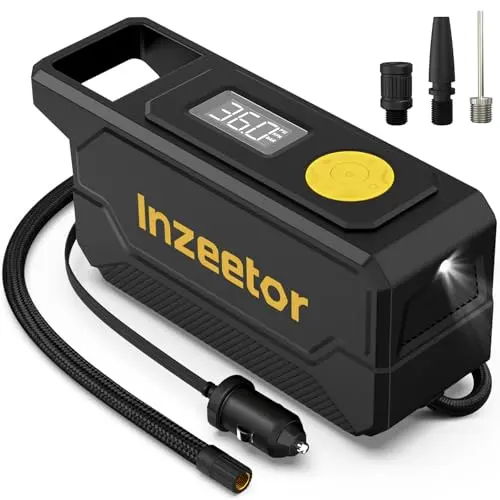
A portable air compressor is correctly sized only when it can reach the required pressure, deliver enough airflow for the task, and repeat that work without exceeding its documented runtime or duty cycle. Maximum PSI alone cannot answer that question. Tire volume, pneumatic-tool air consumption, tank reserve, recovery time, power source, hose losses, and how often the task repeats all change the answer.
Quick Answer
Choose a compact tankless inflator for occasional tire top-offs and inflatables; choose a small tank compressor for nailers and short bursts from compatible air tools; and move to a higher-output compressor when a sprayer, sander, grinder, or other tool needs sustained airflow. Match the compressor's published CFM or SCFM at the tool's working pressure, then allow practical headroom for cycling, hose losses, and normal variation. Treat tank size as stored reserve—not as a substitute for pump output.
This guide connects the focused advice in our home-garage compressor guide, tire-inflator sizing guide, pancake-versus-hot-dog comparison, and corded-versus-cordless guide. Use it when the shopping question is broader: What compressor class fits all the jobs I actually expect to do?
Start With the Air-Use Profile, Not the Compressor
Write down every intended task before comparing products. For each task, record the required pressure, the published air-consumption figure, how long the tool normally runs, how often the cycle repeats, and where the work happens. A driver topping off four tires once a month has a different air-use profile from a trim carpenter firing a nailer throughout a project. A hobbyist using an impact wrench in short bursts has a different requirement from someone running a pneumatic sander continuously.
The hardest recurring job should drive the compressor choice. Buying around the easiest task often produces a unit that reaches the required PSI but cannot maintain airflow. Buying around an unlikely industrial task can create the opposite problem: unnecessary weight, noise, cost, storage demand, and electrical load.
| Primary use | Usually suitable class | Specification that decides the fit | Common sizing mistake |
|---|---|---|---|
| Emergency passenger-tire top-offs | Compact 12V, cordless, or dual-power inflator | Target pressure, tested inflation time, cord and hose reach, cooldown | Choosing by maximum PSI while ignoring tire volume and runtime |
| SUV, pickup, trailer, or repeated tire service | Higher-output inflator or portable tank compressor | Performance on the actual tire size and repeated-cycle limit | Assuming passenger-car performance scales to larger tires |
| Brad nailer, finish nailer, or stapler | Small pancake, hot-dog, or compact tank model | Tool consumption at working pressure and recovery between bursts | Buying more tank than needed while overlooking carry weight and noise |
| Intermittent impact-wrench or ratchet work | Tank compressor with verified burst capacity and pump output | Tool SCFM, hose diameter, regulator flow, and recovery | Expecting a small tank to support long continuous tool cycles |
| Spraying, sanding, grinding, or other sustained demand | Higher-output tank compressor; many compact units are unsuitable | Continuous airflow, duty cycle, electrical supply, moisture control | Treating a high PSI label as evidence of adequate continuous CFM |
| Garage blow-off and general maintenance | Regulated tank compressor with appropriate nozzle and protection | Controlled outlet pressure, guarding, PPE, and safe work practice | Using compressed air on skin, clothing, or unguarded debris |
Compare Portable Air Compressors on Amazon
Step 1: Separate Pressure From Airflow
Pressure, expressed in PSI, is the force available at the outlet. Airflow, commonly expressed as CFM or SCFM, describes the volume delivered over time. A compressor can build high pressure slowly and still be a poor match for an air-hungry tool. That is why maximum PSI is useful for confirming that a target pressure is reachable, but it is not a complete sizing number.
For a pneumatic tool, find the manufacturer's air-consumption value at the stated operating pressure. Compare like with like: a compressor rating at one pressure should not be casually compared with a tool figure at another. If a seller omits the pressure attached to a CFM claim, use the manual or manufacturer documentation before treating the number as a sizing input.
SCFM is a standardized airflow expression, but reference conditions and test methods can still matter. CFM may describe airflow under specified operating conditions. The practical shopping rule is simple: use ratings presented under comparable conditions, and give more weight to a complete performance table than to a large isolated number on a product image.
Step 2: Build in Working Headroom
A compressor that only equals a tool's published consumption on paper may cycle continuously or lose working pressure after hose, coupler, regulator, temperature, and normal production variation are added. For home-garage planning, a modest margin above the stated demand is sensible. A 25% to 50% allowance can be used as an editorial planning screen, not as a universal engineering rule; demanding, continuous, or simultaneous uses require the equipment manufacturers' sizing method.
For one intermittent tool, multiply its published SCFM by the chosen planning factor. For example, a tool listed at 4 SCFM would produce a preliminary screen of 5 SCFM with a 25% allowance. That does not guarantee compatibility: confirm the pressure, duty-cycle definition, hose, regulator, electrical supply, and tool instructions before buying.
If two tools will genuinely run at the same time, account for both rather than selecting only the larger number. If they are never simultaneous, model the real sequence and recovery periods. Avoid adding every tool in the garage as though all will operate continuously; that inflates the requirement without describing the work.
Browse Portable Compressor Formats and Published Specifications
Step 3: Decide Whether You Need a Tank
A tank stores compressed air and supplies a short reserve. It can smooth intermittent demand, reduce rapid cycling, and give a nailer or impact tool a useful burst before pressure falls. It does not increase the pump's sustained airflow. Once the reserve is depleted, recovery depends on compressor output.
Tankless inflators are appropriate when the job is to move a moderate amount of air into a tire or inflatable and then stop. Small tanks suit tools that work in pulses. Larger portable tanks extend the time between recovery cycles, but they also increase weight and storage footprint. If the pump remains below the tool's sustained demand, more gallons delay the interruption rather than eliminate it.
Choose tank layout after confirming output. A pancake design emphasizes a low, stable footprint. A hot-dog compressor may carry naturally and store along a wall. A wheeled vertical tank concentrates capacity into less floor area but still requires a clear transport route and drain access. The best shape is the one that fits both the job and the storage map.
Step 4: Match Runtime and Duty Cycle
Duty cycle describes how much operating time is permitted within a specified interval and under stated conditions. A percentage is meaningless without knowing the interval, pressure, and temperature behind it. Read the manual for the permitted run/rest pattern and any cooldown requirement.
This is especially important for repeated tire inflation. A compact inflator may handle a routine top-off but require rest after one or more long cycles. Larger truck, trailer, and recreational-vehicle tires contain more air than typical passenger tires, so a unit that reaches the target PSI can still be frustratingly slow or thermally limited.
For garage tools, listen to the work rhythm. If the compressor recovers during normal pauses, a smaller unit may be practical. If the motor runs nearly without stopping and the tool loses performance, the system is undersized, restricted, or being used outside its intended cycle. Stop and diagnose rather than defeating thermal protection or extending the run beyond the manual.
Compare Tire Inflators and Portable Tank Compressors
Step 5: Size Tire Inflation by Volume, Pressure, and Repetition
For tires, start with the vehicle manufacturer's recommended cold inflation pressure—not the maximum molded into the tire sidewall. The current NHTSA TireWise guidance directs drivers to the Tire and Loading Information Label on the driver's door edge or the owner's manual and defines a cold reading as one taken after the vehicle has been parked for at least three hours.
Then consider tire volume and starting pressure. Adding a few PSI to a passenger-car tire is an easier job than filling a large pickup tire from a substantially low condition. Manufacturer inflation-time claims are useful only when the test identifies tire size, starting pressure, target pressure, power source, and ambient conditions. Reject comparisons that hide those inputs.
For routine vehicle use, examine gauge resolution, automatic shutoff behavior, hose reach to all four wheels, power-cord reach, storage, and the ability to operate from the intended outlet or battery. For emergency use, also consider visibility, setup beside traffic, fuse requirements, battery maintenance, and whether the device can be operated without routing a cord across a hazardous area.
Step 6: Choose the Power Source Around the Work Location
12-Volt DC Inflators
A 12V inflator is useful for roadside and vehicle storage when its plug and current requirements match the vehicle connection. Check the manual before using an accessory socket; some higher-draw units connect directly to a battery. Cord length, fuse rating, engine-running instructions, and voltage-drop warnings are product-specific.
Cordless Compressors
Cordless models remove the outlet constraint and can be efficient for quick top-offs or remote trim work. Runtime depends on battery capacity, temperature, load, and the compressor design. Confirm whether the listing includes a battery and charger, and compare the cost of a complete operating kit rather than a bare tool.
120-Volt Compressors
Corded compressors suit a garage where repeatable output matters. Verify voltage, amperage, circuit requirements, and extension-cord restrictions in the manual. When the manufacturer permits it, keeping the electrical run short and using a correctly sized air hose or hose reel may be preferable to a long undersized extension cord.
Shop Portable Compressors by Power Source
Step 7: Account for the Entire Air Path
The compressor is only one part of the system. Hose inside diameter, length, fittings, quick couplers, regulator capacity, filters, and moisture separators can restrict flow. A tool can perform poorly even when the compressor's label appears adequate if the air path is undersized or leaking.
Use components rated for at least the system's operating pressure and follow the lowest-rated component. Check compatibility rather than forcing fittings. Route hoses away from door tracks, hot surfaces, sharp edges, vehicle paths, and walking lanes. The Compressed Air Systems hub connects compressors, regulators, fittings, hoses, and reels into one planning path.
Moisture matters for tanks and for finish-sensitive tools. Drain the receiver and service filters according to the compressor manual. Never open a drain, disconnect a hose, or service a component before following the documented shutdown and depressurization procedure.
Use-Case Sizing Walkthroughs
One Vehicle and Emergency Top-Offs
Choose a compact inflator that reaches the placard pressure for the vehicle's tires, has enough cable and hose to reach every valve, and publishes a realistic inflation time and cooldown. A tank and tool-oriented SCFM rating are not automatically necessary. Storage stability, readable controls, and dependable power access matter more than a dramatic gallon figure.
Two Vehicles, Bicycles, and Household Inflatables
A higher-output tankless model, dual-power inflator, or small compressor may reduce waiting when jobs repeat. Confirm the adapters are appropriate and removable, because high-volume inflatables and high-pressure bicycle applications can require different behavior. Never assume one automatic shutoff setting is correct for every item.
Trim, Furniture, and Occasional Nailer Projects
Start with the nailer's published operating pressure and air consumption. A compact tank model often fits because the tool fires intermittently and the compressor recovers between bursts. Compare carry weight, stability, hose management, sound, and the number of users. Our quiet-compressor guide explains why the published decibel number should be considered alongside recovery frequency.
Automotive Tools in a Home Garage
List each air tool and separate brief impact-wrench use from sustained grinding or sanding. Compare published demand at the working pressure, not marketing torque or compressor horsepower. A portable tank can support some intermittent tasks, while continuous tools may expose the limits quickly. Consider whether an electric or cordless version of the highest-demand tool is the more practical solution.
Painting and Surface Preparation
Sprayers and air-powered surface-preparation tools can require sustained, clean airflow. Use the tool or gun manufacturer's pressure and consumption data, then account for moisture control and the full hose path. Many compact portable compressors are not designed for this workload. Do not buy on tank size alone.
Review Current Portable Air Compressor Options
Safety Rules That Affect the Purchase
Compressed air can propel chips, damage components, and cause severe injury. Never direct it at skin or clothing. In U.S. workplaces, OSHA standard 29 CFR 1910.242(b) restricts compressed air used for cleaning to less than 30 PSI and requires effective chip guarding and personal protective equipment. That workplace limit does not make casual blow-off safe; use the correct nozzle, controls, guarding, and protection for the task.
Place the compressor on a stable surface with required ventilation clearance. Inspect the cord, plug, hose, tank, fittings, drain, regulator, and safety devices. Do not weld, drill, patch, or otherwise modify a receiver tank. Do not bypass guards, thermal protection, relief valves, or grounding. Use only compatible components and follow the exact manual for break-in, oil, draining, transport, storage, and service.
Noise exposure depends on level, distance, duration, room reflection, and recovery frequency. A product described as quiet may still warrant hearing protection or relocation. Do not cover a compressor to reduce noise; that can block cooling and intake airflow.
Portable Compressor Rejection Checklist
- Reject it if the seller gives maximum PSI but no useful airflow or inflation-performance data for the intended job.
- Reject it if the tool demand and compressor output are stated at incompatible pressures with no complete performance curve.
- Reject it if the required run time conflicts with the documented duty cycle or cooldown.
- Reject it if the complete weight, shape, handle, cord, hose, and drain access do not fit the storage and transport route.
- Reject it if the available outlet, vehicle socket, battery, or circuit does not meet the manual's power requirements.
- Reject it if required fittings, regulator range, hose diameter, or accessories cannot be verified.
- Reject it if the tank or safety components show damage, unauthorized repair, heavy corrosion, or missing documentation.
Browse the full Portable Air Compressors collection after completing the checklist. Shoppers whose highest-demand job exceeds a portable model should compare the broader Air Compressors collection instead.
Frequently Asked Questions
How much SCFM should a portable air compressor have?
There is no universal number. Use the highest recurring tool demand at its stated working pressure, then add reasonable planning headroom and confirm the manufacturer's sizing method. Tire inflators may be better compared by verified inflation time, tire size, pressure range, and duty cycle when SCFM is not published.
Does a larger tank mean more CFM?
No. A larger tank stores more compressed air and can lengthen a burst before recovery. Sustained CFM comes from the pump and motor system. A larger tank paired with the same output changes the work rhythm, not the underlying refill rate.
Can a portable tire inflator run a nail gun?
Most tankless tire inflators are not designed as pneumatic-tool supplies. A nailer needs regulated air at its specified pressure plus compatible fittings and adequate delivery. Use a compressor whose manufacturer documents tool compatibility and output at the required pressure.
What portable compressor is best for both tires and nailers?
A compact tank compressor can cover both when it reaches the vehicle's recommended tire pressure and meets the nailer's published airflow demand. It will usually be heavier and slower to deploy roadside than a dedicated inflator. Choose based on where the combined use actually occurs.
How much extra compressor capacity should I buy?
Enough to prevent the normal job from sitting at the edge of the published rating, but not so much that transport, storage, power, and noise become unreasonable. A 25% to 50% planning allowance is a useful first screen for some home-garage tasks, not a substitute for manufacturer sizing or an engineering calculation.
Why does my air tool feel weak even when the compressor is large enough?
Check actual regulated pressure during use, hose diameter and length, restrictive couplers, leaks, filter condition, moisture control, and recovery behavior. The compressor may meet a label comparison while the complete air path prevents adequate flow.
Final Verdict
Size a portable air compressor in this order: define the hardest recurring job, verify its pressure and airflow, add appropriate working headroom, choose enough tank reserve for the work rhythm, confirm duty cycle, and then validate power, hose, fittings, noise, weight, and storage. A compact inflator is often the right answer for tires. A small tank model is often the useful middle ground for nailers and short tool bursts. Sustained spraying, sanding, and grinding may require a higher-output compressor or a different tool platform entirely.
The strongest purchase is not the model with the biggest PSI or tank number. It is the smallest practical system that meets the documented demand without being pushed beyond its instructions. Compare the current portable compressor lineup, then use the Garage Equipment & Car Care hub to coordinate tire, lifting, electrical, and maintenance equipment around the same workspace.